The point of summer practice isn't to grind: it's to build habits and self-awareness that survive the school year. Below is a breakdown of how to think about practice, what to actually do, and a sample daily structure. Read it once through, then come back to specific sections as you need them.
Start with Questions
Before you touch the piano, sit with these three questions. Write the answers down somewhere you'll see them again: your Apple Notes, your notebook, a note on your computer, a tattoo on your toe.
What do I want to learn?
Be specific. "Get better at jazz" is not a learnable thing. "Comp through All The Things You Are without stopping at the bridge" is. The more concrete the target, the easier it is to know whether you're moving toward it.
What are my weakest traits?
This is the uncomfortable one. Be honest. Is it your time? Your reading? Do you panic when you see a half-diminished chord? Do you only solo well over modal tunes and fall apart on rhythm changes? Naming the weakness is half the work. Most students avoid practicing what they're bad at because they're bad at it, and that's exactly the loop you have to break.
What are my strongest?
Equally important, and easier to forget. Your strengths are leverage. If you have great ears, use them to learn tunes faster. If you have strong technique, use it to develop unique phrasing that makes the most of it. You'll also play better in any session if you know what you can lean on when things get shaky.
Goals vs. Systems
This distinction matters more than it sounds. Goals are destinations. Systems are the things you do every day that move you in their direction. Goals tell you whether you've arrived; systems are how you actually get there. If you only set goals, you'll feel guilty every day you haven't reached them. If you only build systems, you'll improve but you won't know toward what.
Goals
These are outcomes: concrete, observable, finishable.
Example from students:
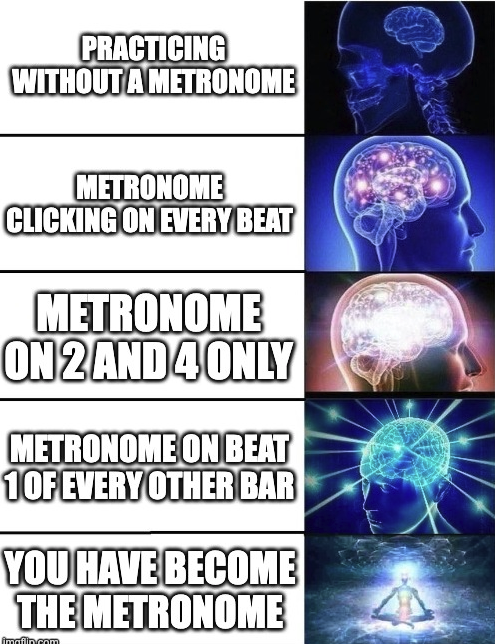
- Playing in time. Time is the foundation. Without it, no amount of harmonic knowledge matters. By the end of summer, you should be able to play a chorus of medium-tempo blues with a metronome on 2 and 4 without rushing or dragging.
- Harmonize a melody. Take a simple tune (a standard, a folk melody, a Christmas song. Anything!) and reharmonize it using your own voicings and substitutions. This forces you to use harmony actively rather than just label it.
- Reading charts. Get to where you don't panic when you see a
Cø7or a long melody. Reading isn't about sight-reading speed for jazz. It's about recognition and fluency. You should see a chord symbol and know at minimum: what scale fits, what the guide tones are, what voicing you'd grab.
Suggested Goals
- Listen to more jazz. Pick a focus. The Art of the Trio Vol 3, Songs (Brad Mehldau) is a great one. So is everything Herbie Hancock did, or Keith Jarrett, or Bill Evans with LaFaro and Motian, or Chet Baker, Miles: anyone of the greats. Start with the greats before going to the fringe. The point is deep listening, not background music: try to hear the form, the comping, the interplay. Listening is practice.
- Establish a repertoire of 10 tunes. Include at least a blues. Ten well-known tunes you can play in any key, from memory, in any setting, is more useful than thirty tunes you sort-of-know. Suggested mix: 1 blues, 1 rhythm changes, 2 ballads, 3 medium swing standards, 1 bossa, 1 modal tune, 1 wildcard you love.
Systems
This is the daily work. None of these are exciting. All of them compound.
Working on Harmony
Harmony is a language. You're trying to internalize it so it becomes available in real time, not so you can describe it on a test.
- Diatonic substitutions. Within a key, certain chords can replace each other because they share function.
I → vi,I → iii,IV → ii,V → viiø. Practice these by taking a simple progression (I–IV–V–I) and playing every variation you can derive. Get the sound in your ear, not just on the page. - Secondary dominants. Any chord can be preceded by its own V7.
ii–V–IbecomesV/ii–ii–V–I, and now you've turned a simple cadence into a longer harmonic phrase. This is how standards get their motion. Pick a tune, find every spot a secondary dominant could be inserted, then play it both ways and listen. - Substitutions in general. Diatonic and tritone subs, modal interchange, line cliché motion: these are the tools that turn a stock progression into something personal. Don't try to learn them all at once. Pick one substitution per week and force yourself to use it in every tune you touch.

Voicings from a Lead Sheet
A lead sheet gives you a melody and chord symbols. Everything else is your decision. That's where voicings live.
- Plain vs. Textured. Same chord, different sonic worlds. A
Cmaj7voiced1–3–5–7is plain. Voiced3–7–9–13offers more texture. Drop the 5, add a#11, move some voices closer, voice it low and now it's darker, denser. Practice playing the same chord in two emotional registers back to back. Learn what each voicing wants to do next. Keep into account the octave too: dark vs bright. - Voicing structures:
1 7 3 5(6) 9and1 3 7 9 5. These are two reliable adjacent shapes. Learn them onCmaj7, thenDmi7, thenG7, then move them through the cycle of fourths. The point isn't memorization, it's that your hands learn the shape of a chord and get used to play roots, shells, extensions. - Left-hand voicings for trio playing. When you have a bassist, you don't need the root. Drop it. The classic shells,
3–7and7–3, expanded to3–5-6–9or7–9–3–13. Leave space for your right hand to breathe. Transpose them through all twelve keys. Slowly, accurately, with no metronome at first, then with one.
Transposing
Transposing is the test of whether you actually know something. If you can play a ii–V–I in C but not in E, you don't know ii–V–I. You know it in C. Take any small idea (a voicing, a motif, a four-bar phrase) and move it through the cycle of fourths or chromatically. Try to use your ears as guide, only escalate to reasoning when your ears fail. This single discipline does more than any other to convert head-knowledge into hand-knowledge.
Transcribing
Transcribing is the secret weapon. You're learning rhythm, phrasing, articulation, harmonic logic, and time all at once by stealing from someone who already plays the way you want to play.
- Pick short phrases: four bars, eight bars max.
- Learn them by ear before you write them down.
- Once you have them, play them along with the recording until your time matches.
- Then transpose them. Now they're yours.

Tapping 2 and 4 While Playing
Sit at the piano. Tap your left foot on beats 2 and 4 (the backbeat). Now play. This is harder than it sounds and it will instantly reveal whether your time is real or imaginary.
- Just the melody. Play the head of a tune while keeping the foot rock-steady on 2 and 4. If your foot speeds up, your time is being driven by your hands, not by an internal pulse. Fix that.
- Melody with extreme attention to articulation. Now do the same thing but obsess over how each note is attacked, sustained, and released. Where does the swing live? In the spaces between notes. Listen to how Wynton Kelly or Red Garland articulate a single phrase: that's what you're after!
Playing with the Metronome
The metronome is not a crutch. It's a mirror. It reflects whether your time is real.
- 8th-note exercise. Set the metronome to a slow tempo (60–80 bpm) on beats 2 and 4. Play continuous 8th notes through a scale or a chord changes. Stay locked in. Do this for ten minutes. It's brutal and it works.
- Accents within scales. Same exercise, but now accent specific notes: the upbeats, then every third note, then every fifth. This builds rhythmic flexibility inside steady time, which is what swing actually is.
Improvisation Concepts
Improvisation isn't one skill. It is a stack of skills you can practice independently and then recombine.
- Rhythmic themes. Pick a single rhythm: say, a syncopated three-note figure. Play it on different pitches throughout a chorus. The point is to make a coherent solo using only rhythmic development. This is how Sonny Rollins thinks. Most students improvise pitches and ignore rhythm; this exercise forces the inverse.
- Melodic ideas regardless of rhythm. The opposite drill. Pick an interval (a 4th, say) or a small melodic cell. Play it in different rhythms, in different registers, over different chords. Now you're developing a motif the way a composer would.
- The arc of a long solo. Most student solos are flat. They peak in bar 4 and stay there. Or they are messy, with no peak at all. An idea follows another, with no rhyme or reason. Practice building a chorus that starts simple, develops, climaxes, and resolves. Practice using a single idea for a whole chorus. Listen to how heavy cats organize their solo with this in mind. The shape is the thing, man!
- 4 notes + rests, 8 notes + rests. Constrain yourself. Play four notes, then rest. Play eight notes, then rest. Solo this way for a full chorus. It teaches you that space is part of the line. Most students fear silence; the great players use it.
Basic Building Blocks
These are the warm-ups. Don't skip them. They're where ear, hand, and time meet.
- Drone. Play a single tonic drone in your left hand (or with an app/or instrument) and improvise melodically over it: first singing, then playing. No chord changes, no harmonic pressure. Just you, a tonic, and your ear. Five minutes of this every day will transform your phrasing.
- 8th-note exercise (platform / flavor). "Platform" = scale or mode. "Flavor" = the alterations you're adding (
b9,#11, etc.). Pick a platform, pick a flavor, play 8th notes through it with the metronome. This is how you internalize altered sounds without thinking. - Scales on your repertoire. For every tune in your 10-tune list, run the appropriate scale on every chord. Slowly. With time. Until the relationship between chord symbol and scale shape is automatic.
Learning Repertoire
The protocol that works:
- Listen to 2–3 versions of the tune before you touch the piano.
- Try to learn the melody by ear. Get as far as you can.
- Then look at the lead sheet to fill in the gaps and check yourself.
- Break the tune into 4- or 8-bar chunks. Don't try to learn 32 bars at once. Chunking is everything.
- Once the melody is solid, learn the changes the same way: chunk by chunk.
- Then voicings, then soloing.
Sample Practice Day
This is 45 minutes. It's enough. More than this and you're probably losing focus; less and you're not building the habit. Adjust as you like, but keep the structure: warm-up, new material, technique, reward, application.
| Time | Activity |
|---|---|
| 5 min | Drone: improvise melodically over a tonic |
| 10 min | Learn a new song (e.g., Days of Wine and Roses) from ear first, then lead sheet. First 4–8 bars only. Break into chunks. |
| 10 min | Voicings: take the first 4 bars of a standard you are working on, and work out left-hand voicings |
| 10 min | Reward time: improvise something fun, no rules |
| 10 min | 8th-note exercise on the first 4 bars of one of you repertoire pieces. Last 2 minutes with metronome |
The reward block is not a joke. If practice is only discipline, you'll quit. The reward block is where you remember why you started.
Reference: Diatonic Substitutions
Chords that share a function in a key can substitute for each other. Memorize this table and start hearing the categories instead of the individual chords.
| Function | Chords |
|---|---|
| Tonic (I) | I, vi, iii |
| Subdominant (IV) | IV, ii |
| Dominant (V) | V, vii° |
In C major:
| Function | Chords |
|---|---|
| Tonic | Cmaj7, Ami7, Emi7 |
| Subdominant | Fmaj7, Dmi7 |
| Dominant | G7, Bø7 |
Practice: take a tune you know, identify the function of each chord, then play it again replacing one chord per phrase with a same-function substitute. Listen to what changes.
If it helps, here is Jazz Practice Cheatsheet.
A Final Note
Those who improve fastest aren't the ones who practice the most hours. They're the ones who practice with the most attention. We call this deliberate practice. Twenty focused minutes beats two distracted hours. If your mind wanders during the metronome exercise, stop, take a breath, and start again. Your ears need to be in the room.
Have a great summer. Steal from records. Play with people whenever you can. And keep a list of every tune you learn.